Ready or not, here comes the Big Dumb Sport
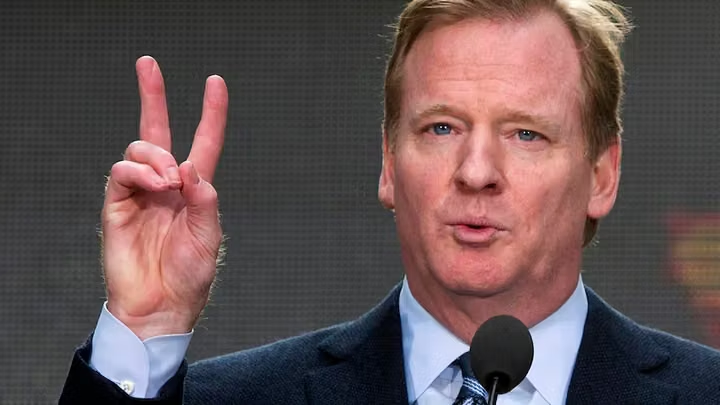
The NFL's 2026 regular season starts next week when the Patriots play the Seahawks on Wednesday evening. Yes, Wednesday: the league's perennial quest to monopolize every night of primetime television continues, much to the delight of our country's legion of football zealots and much to the dismay of their wives, partners, family members, and friends who may be slightly weary of The Game That Gives You Brain Trauma.
Of course, it isn't so neatly split between the football lovers and the football haters; I myself fall somewhere in the middle, as do millions of others. It's difficult if not impossible to be raised in the Midwest without engaging with the sport of football in some capacity–as a player, as the sibling of a player, as a fan, as the friend of a fan, as a reluctant attendee of your high school's Homecoming game. As a Nebraskan, you'd have to actively, fervently avoid most places–most social situations–for half of the year to get away from Cornhusker football. It's annoying and tiresome, wondrous and unifying all at once.
For the next 16 weeks, I'll be tuning in regularly, sometimes passively, sometimes quite ardently, all while loudly voicing criticisms that, by this point, have become so hopelessly multitudinous that it feels akin to speaking out against the American government itself. The CTE, horrible as it is, is but one item on an increasingly long list of ethical dilemmas, conflicts of interest, programmed injustices, hypocrisies, and scandals. As is the case with so many dominant American cultural institutions, the NFL gets away with it because it makes so much damn money.
Even the not-so-politically-inclined have become irritated if not straight-up overwhelmed by the ubiquitous commercialization of American football. This shit is everywhere. The NFL is certainly the primary culprit, but NCAA football–which has effectively become the Minor Leagues, especially after NIL policy changes–also runs constant commercials and advertisements across cable television, streaming platforms, and social media. The rapid ascension of sports betting has made it even harder to stomach, from both an ethical perspective (what do you mean an athlete can be paid to promote a platform where users can bet on THAT SAME PLAYER'S PERFORMANCE in real time?) and from a media saturation perspective: when is the last time you watched anything with ads without being subjected to the base horror of a FanDuel or BetMGM promo (this Jon-Hamm-narrated one is especially dark)?
It's easy to get lost in all of the noise surrounding football season and forget that this is an intensely violent sport where very large men chase, charge, and crash into each other at full speed. The rules, in constant flux, are interpreted by half a dozen men who run around the field and watch as intently as they can without getting too close to the juggernauts trying to bring each other to the ground. It's really so, so stupid, and tons of football fans will tell you as much. So why do we watch? Why does this dumb, brutal sport have such a grip on our national attention? I don't have a good answer, other than that we–Americans, humans–consume a lot of media we know to be problematic or "trashy" or ultimately pointless, and so long as we remember to be critical of them, and epsecially of the people in charge of them, maybe it's okay. The issue has been that the NFL seemingly answers to no one, and their players have little to no organizational power themselves (see: Colin Kaepernick). The NFL Players Association is perhaps the weakest union in all of professional sports, lacking significant bargaining power and offering little to no control over the direction of players' careers.
So I urge my fellow hate-watchers–and even those who maybe haven't or don't like to think about the political implications of sports–to keep talking, keep posting, keep writing inconsequential blog posts for a handful of readers. We should always demand more of the things we love, even something as difficult to love as football.